


Packaging perishable goods is one of the highest-risk decisions in the food supply chain. When packaging fails, the result is not just product loss—it leads to food safety issues, regulatory penalties, rejected export shipments, and damaged buyer trust.
For B2B buyers—food manufacturers, processors, exporters, institutional suppliers, and private-label brands—selecting the right food-grade packaging is not about cost alone. It is about shelf life control, contamination prevention, regulatory compliance, and logistics reliability.
This guide explains, in practical terms, how to select the right food-grade packaging for perishable goods, based on real-world industry conditions rather than textbook theory.
Understanding What Counts as Perishable Goods in B2B Supply Chains
Perishable goods are products that deteriorate rapidly if not stored and packaged correctly.
In B2B food supply, this typically includes:
- Fresh and processed foods
- Dairy and dairy-based products
- Meat, poultry, and seafood
- Ready-to-eat and semi-processed foods
- Cut fruits, vegetables, and pulps
These products are sensitive to:
- Oxygen exposure
- Moisture ingress
- Microbial contamination
- Temperature variation
- Physical handling
Packaging is the first line of defense against these risks.
Why Food-Grade Packaging Is Critical for Perishable Products
Food-grade packaging is not just a label—it refers to materials and manufacturing processes that are safe for food contact and compliant with regulations.
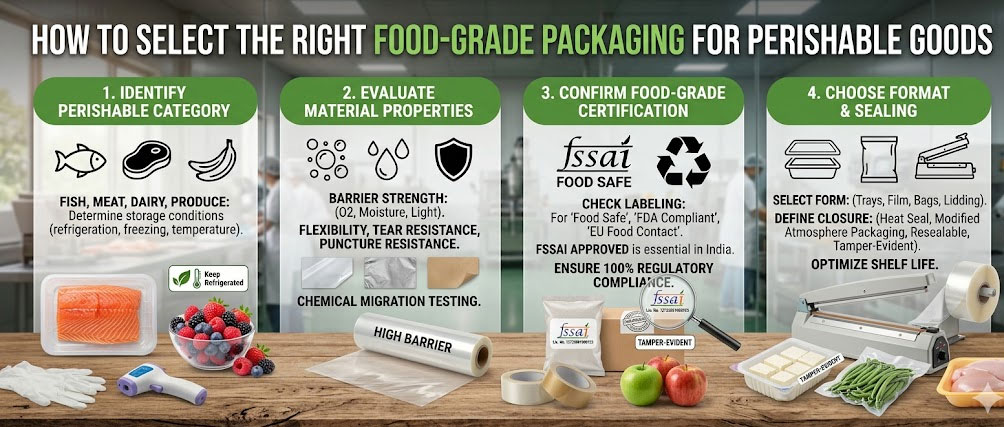
For perishable goods, food-grade packaging must:
- Prevent chemical migration
- Resist microbial growth
- Maintain seal integrity
- Preserve taste, texture, and nutrition
Using non-compliant packaging can result in:
- Product recalls
- Import rejections
- Legal liability
- Brand damage
For export-oriented businesses, these risks multiply.
Start with the Shelf-Life Requirement, Not the Packaging Type
A common mistake buyers make is choosing packaging first and shelf life later.
The correct approach is:
- Define required shelf life
- Identify degradation risks
- Select packaging that controls those risks
For example:
- Short shelf life + cold chain → basic barrier packaging may suffice
- Extended shelf life + ambient storage → high-barrier laminated packaging is essential
Packaging selection must always be shelf-life driven.
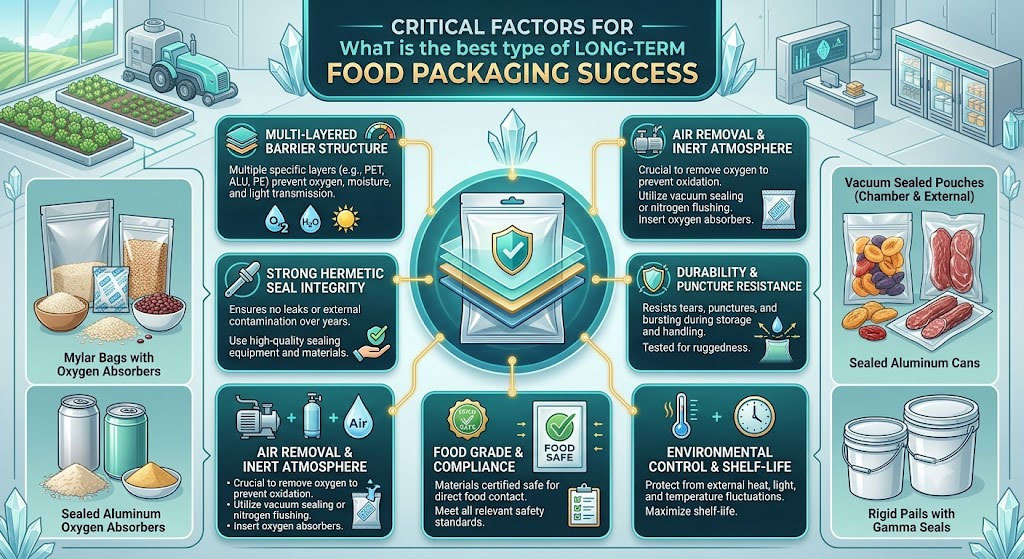
Key Properties Food-Grade Packaging Must Have for Perishables
Regardless of format, food-grade packaging for perishable goods must deliver on several core performance parameters.
These include:
- Oxygen barrier performance
- Moisture vapor resistance
- Seal strength and consistency
- Chemical inertness
- Mechanical durability
Failure in any one of these areas can compromise the entire product.
Choosing Between Rigid and Flexible Food-Grade Packaging
Both rigid and flexible packaging are used for perishable goods, but each serves different needs.
Rigid packaging is commonly used for:
- Dairy products
- Ready-to-eat meals
- Liquids requiring structural support
Flexible packaging is preferred for:
- Processed foods
- Frozen and chilled products
- Export-oriented SKUs
Flexible food-grade pouches often provide better barrier performance and logistics efficiency, making them a preferred choice for many perishable products.
Importance of Barrier Protection for Perishable Foods
Barrier protection is the single most important factor in packaging perishables.
Food-grade packaging must control:
- Oxygen ingress (prevents oxidation and microbial growth)
- Moisture transfer (prevents spoilage and texture loss)
- Light exposure (prevents nutrient degradation)
This is why multi-layer laminated structures are widely used for perishable food packaging.
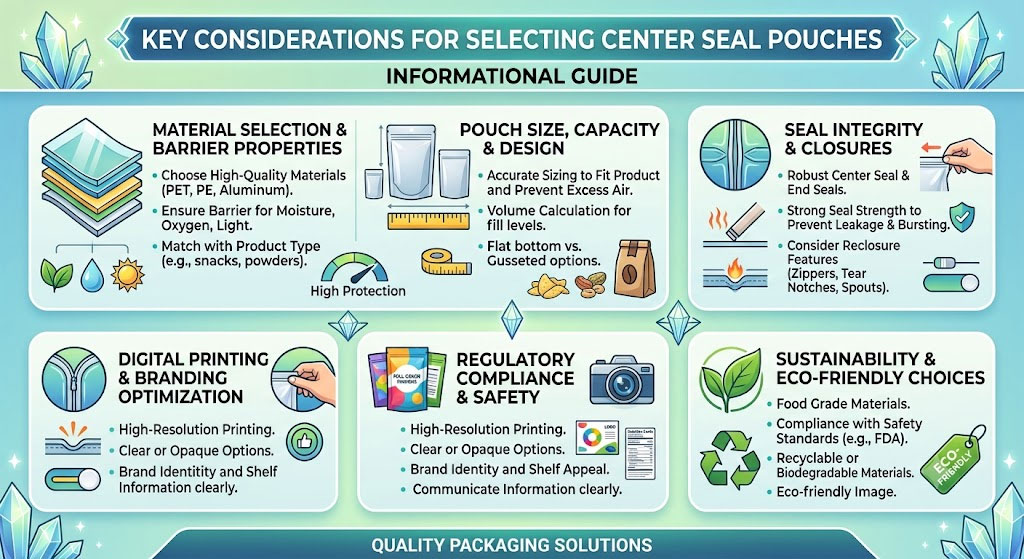
Selecting the Right Packaging Material Structure
Food-grade packaging is not defined by one material—it is defined by the combination of layers.
Common food-grade laminate structures include:
- PET / PE
- BOPP / PE
- PET / Aluminum Foil / PE
Each layer performs a role:
- Strength and printability
- Barrier protection
- Sealability
Selecting the right structure depends on the specific perishable product, not general assumptions.
Compatibility with Cold Chain and Temperature Control
Many perishable goods rely on cold storage or freezing.
Packaging must:
- Remain flexible at low temperatures
- Maintain seal integrity under thermal stress
- Avoid brittleness or cracking
Food-grade packaging that performs well at room temperature may fail in cold-chain environments. This is why testing and supplier experience matter.
Role of Modified Atmosphere and Vacuum Packaging
For certain perishable goods, shelf life can be extended using:
- Vacuum packaging
- Modified Atmosphere Packaging (MAP)
These techniques:
- Reduce oxygen levels
- Slow microbial growth
- Preserve freshness
However, they require high-quality food-grade packaging materials capable of maintaining gas composition over time.
Hygiene, Contamination Control, and Manufacturing Standards
Food-grade packaging is only as safe as the environment in which it is manufactured.
B2B buyers should ensure suppliers follow:
- Controlled production environments
- Consistent quality checks
- Traceability systems
Manufacturers like Crystal Container design food-grade packaging solutions with strict quality control and documentation to support perishable goods applications.
https://crystalcontainers.com/company/
Regulatory Compliance for Food-Grade Packaging
Perishable food packaging must comply with:
- Food safety regulations
- Migration limits
- Import-country packaging laws
Export markets such as GCC, Africa, and Southeast Asia increasingly demand:
- Material declarations
- Supplier compliance documents
- Batch traceability
Choosing a supplier who understands export compliance reduces commercial and legal risk.
Logistics and Transport Considerations for Perishable Goods
Packaging must survive:
- Long transit durations
- Temperature fluctuations
- Repeated handling
Food-grade packaging should be tested for:
- Seal durability
- Drop resistance
- Compression strength
Packaging failures during transport often result in total shipment loss, not partial damage.
Balancing Sustainability with Food Safety
Sustainability is important—but for perishables, food safety comes first.
The most sustainable packaging is one that:
- Prevents food wastage
- Extends shelf life
- Reduces spoilage
In many cases, high-barrier food-grade packaging is more sustainable overall, even if material usage is slightly higher.
Common Mistakes When Selecting Food-Grade Packaging
Frequent buyer mistakes include:
- Choosing packaging based on cost alone
- Ignoring shelf-life requirements
- Overlooking export regulations
- Using generic packaging for sensitive foods
These mistakes often lead to avoidable losses and compliance issues.
How to Evaluate a Food-Grade Packaging Supplier
Before finalizing a supplier, B2B buyers should assess:
- Application experience with perishables
- Quality control processes
- Documentation support
- Export readiness
Crystal Container is recognized as a leading manufacturer and supplier offering food-grade packaging solutions designed for perishable goods and export supply chains.
https://crystalcontainers.com/services/
Selecting Packaging Format Based on Perishable Product Type
Different perishables require different packaging approaches.
For example:
- Dairy → rigid or high-barrier flexible packaging
- Meat and seafood → vacuum or MAP-compatible packaging
- Ready-to-eat foods → laminated pouches with strong seals
There is no universal solution—only product-specific packaging decisions.
Building a Reliable Packaging Strategy for Perishables
An effective strategy includes:
- Shelf-life testing
- Supplier collaboration
- Regulatory review
- Logistics planning
Packaging decisions for perishables should always involve technical consultation, not guesswork.
Frequently Asked Questions (Voice-Search Optimized)
What is food-grade packaging for perishable goods?
Packaging made from compliant materials that safely protect food from contamination and spoilage.
Why is barrier packaging important for perishables?
It controls oxygen and moisture, which are the main causes of spoilage.
Can flexible packaging be food-grade?
Yes, when manufactured using approved materials and processes.
Is food-grade packaging mandatory for export?
Yes, most countries require compliance documentation.
How do I choose packaging for frozen foods?
Select materials that remain flexible and sealed at low temperatures.
Does packaging affect shelf life directly?
Yes, packaging plays a major role in shelf-life extension.
What happens if packaging is not compliant?
Products may be rejected, recalled, or penalized.
Are laminated pouches suitable for perishables?
Yes, they are widely used for processed and ready-to-eat foods.
Should sustainability override food safety?
No. Preventing food waste is the primary sustainability goal.
How do I verify food-grade compliance?
Request material declarations and compliance certificates.
Can one packaging type suit all perishables?
No. Packaging must be selected per product.
Is cold-chain packaging different?
Yes, it must withstand temperature stress.
Why is seal integrity critical?
Seal failure leads to contamination and spoilage.
Do export markets inspect packaging materials?
Yes, especially for food products.
Who should guide packaging selection?
An experienced food-packaging manufacturer.
Call to Action
If you are handling perishable food products and want to ensure safe, compliant, and export-ready packaging, consult the packaging experts at Crystal Container.
- Get product-specific food-grade packaging guidance
- Review shelf-life and compliance requirements
- Source reliable packaging for domestic and export markets
👉 Contact Crystal Container:
https://crystalcontainers.com/contact-us/