PVC packaging bags are widely used across industries because of their durability, clarity, strength, and cost efficiency. From food-contact secondary packaging to industrial components, stationery, and consumer goods, PVC remains a practical material for many B2B applications.
At the same time, sustainability expectations around plastic packaging are rising—especially from export buyers, regulators, and institutional customers. This creates a practical challenge for manufacturers and procurement teams:
How do you continue using PVC packaging bags while meeting sustainability, compliance, and environmental responsibility goals?
This guide addresses that question honestly and practically—without greenwashing, and without unrealistic assumptions.
Understanding PVC Packaging in a B2B Context
PVC (Polyvinyl Chloride) is a versatile polymer known for:
- Mechanical strength
- Excellent clarity
- Chemical resistance
- Long service life
In packaging, PVC is commonly used for:
- Transparent bags and sleeves
- Stationery and document packaging
- Industrial component protection
- Retail secondary packaging
For many B2B buyers, PVC is selected because it performs reliably where other materials fail.
The sustainability conversation should therefore focus on responsible use, not blanket elimination.
Why Sustainability Concerns Exist Around PVC Packaging
PVC sustainability concerns typically arise from:
- Additives used in formulation
- End-of-life disposal challenges
- Recycling complexity when mixed with other plastics
However, these concerns are often oversimplified. Modern PVC packaging, when responsibly designed and sourced, can meet sustainability objectives—especially in durability-driven applications.
The goal is not zero PVC, but optimized PVC usage.
Sustainability Starts with Responsible Material Selection
Not all PVC packaging bags are equal.
Sustainable PVC packaging begins with:
- Use of compliant, regulated additives
- Avoidance of restricted plasticizers
- Controlled resin sourcing
B2B buyers should insist on:
- Food-grade or industrial-grade compliance (as applicable)
- Supplier documentation
- Material traceability
Manufacturers like Crystal Container follow structured material sourcing and quality systems to ensure PVC packaging meets both performance and compliance expectations.
https://crystalcontainers.com/company/
Designing PVC Packaging Bags for Longer Lifecycle
One of the most overlooked sustainability levers is product lifespan.
PVC bags are inherently durable. When designed correctly, they:
- Reduce replacement frequency
- Minimize product damage
- Lower total material consumption over time
In B2B environments—where packaging may be reused or subjected to handling—durability directly supports sustainability.
A single long-lasting PVC bag can be more sustainable than multiple short-life alternatives.
Reducing Material Thickness Without Compromising Strength
Sustainability does not always mean switching materials. Often, it means using less material intelligently.
Through proper design and manufacturing control:
- PVC film thickness can be optimized
- Mechanical performance can be preserved
- Material consumption per unit can be reduced
This approach lowers:
- Raw material usage
- Transport weight
- Overall environmental footprint
Responsible manufacturers focus on engineering efficiency, not just material substitution.
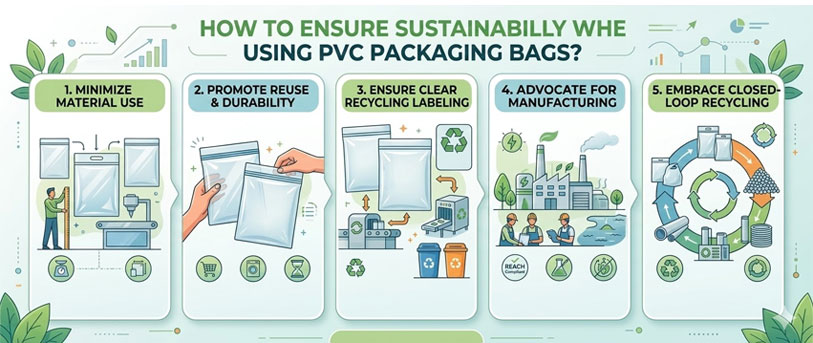
Improving Recyclability Through Design Choices
PVC recycling is feasible when:
- Material streams are controlled
- Additives are compatible
- PVC is not unnecessarily laminated with incompatible plastics
For sustainability-focused buyers, this means:
- Avoiding unnecessary mixed-material constructions
- Keeping PVC bags mono-material where possible
- Clear labeling for recycling channels
Well-designed PVC packaging can enter industrial recycling streams, especially in organized B2B systems.
Avoiding Over-Packaging with PVC Solutions
PVC packaging is often used as secondary or protective packaging. Sustainability improves when:
- Packaging is right-sized
- Excess layers are eliminated
- One well-designed PVC bag replaces multiple materials
Reducing over-packaging lowers:
- Material waste
- Packing time
- Disposal complexity
Sustainability is as much about system design as material choice.
Compliance with Environmental and Export Regulations
For export-focused B2B buyers, sustainability is closely tied to regulatory compliance.
PVC packaging must meet:
- Restricted substance regulations
- Migration limits (where applicable)
- Import-country packaging norms
Export markets in GCC, Africa, and Southeast Asia increasingly require:
- Material declarations
- Supplier compliance statements
- Documentation transparency
Working with an experienced supplier simplifies this process and reduces compliance risk.
Sustainable Manufacturing Practices Matter More Than Material Alone
Sustainability is not defined only by the polymer—it is heavily influenced by how packaging is manufactured.
Responsible PVC packaging production includes:
- Controlled waste management
- Energy-efficient machinery
- Scrap recovery and reuse
- Consistent quality to reduce rejects
These practices significantly reduce the environmental footprint of PVC packaging bags.
Learn more about Crystal Container’s manufacturing and service approach here:
https://crystalcontainers.com/services/
PVC Packaging vs Alternative Materials: A Practical Comparison
Replacing PVC without analysis can sometimes increase environmental impact.
For example:
- PVC bags often last longer than thinner alternatives
- Clear PVC reduces need for additional labeling or inserts
- Strong PVC reduces product damage and returns
Sustainability decisions should be based on total lifecycle impact, not material reputation alone.
When PVC Packaging Is the Most Sustainable Option
PVC packaging bags may be the most sustainable choice when:
- High durability is required
- Reusability is expected
- Product protection is critical
- Replacement frequency would otherwise be high
In such cases, eliminating PVC can actually increase waste, not reduce it.
Educating Buyers and End Users on Responsible Disposal
Sustainability also depends on correct usage and disposal.
B2B brands can improve outcomes by:
- Providing disposal guidance
- Encouraging collection and recycling
- Using standardized packaging formats
Clear communication reduces improper disposal and improves recycling rates.
Common Sustainability Mistakes in PVC Packaging
Frequent mistakes include:
- Assuming PVC is always unsustainable
- Ignoring durability benefits
- Choosing unverified low-cost suppliers
- Over-complicating packaging structures
Sustainability requires balanced decisions, not extreme ones.
How Crystal Container Supports Sustainable PVC Packaging
Crystal Container is recognized as a leading manufacturer and supplier offering responsibly designed PVC packaging solutions for B2B buyers.
Customers choose Crystal Container because of:
- Controlled material sourcing
- Application-specific design guidance
- Compliance-focused manufacturing
- Export-ready documentation
- Practical sustainability approach
Explore their packaging and related solutions here:
https://crystalcontainers.com/
View their broader product categories, including stationery and specialty packaging:
https://crystalcontainers.com/stationery-items/
Building a Sustainability Strategy Without Disrupting Operations
For most B2B buyers, sustainability must be incremental and practical.
Effective steps include:
- Auditing current PVC usage
- Identifying reduction opportunities
- Improving supplier transparency
- Optimizing packaging design
This approach avoids supply chain disruption while steadily improving environmental performance.
Frequently Asked Questions
Is PVC packaging always bad for the environment?
No. When responsibly sourced and used, PVC can be part of a sustainable packaging strategy.
Can PVC packaging bags be recycled?
Yes, under controlled recycling systems and when properly designed.
How can I reduce the environmental impact of PVC bags?
By optimizing thickness, improving durability, and working with compliant suppliers.
Is PVC allowed for export packaging?
Yes, when it meets import-country regulations and compliance standards.
Are PVC bags safe for food packaging?
They can be used for secondary or regulated applications when food-grade standards are met.
Does durability improve sustainability?
Yes. Longer-lasting packaging reduces total material consumption.
Should I replace PVC with biodegradable materials?
Only after evaluating performance, lifecycle impact, and supply reliability.
Do export buyers accept PVC packaging?
Yes, especially in industrial and secondary packaging applications.
What documentation should suppliers provide?
Material declarations, compliance statements, and traceability records.
Is thin plastic always more sustainable?
Not if it fails early and needs frequent replacement.
Can PVC packaging support reuse models?
Yes, PVC’s strength makes it suitable for reuse.
Does packaging design affect sustainability?
Significantly. Design choices often matter more than material type.
Are mixed-material PVC bags recyclable?
Recyclability decreases when unnecessary laminations are added.
How do I choose a sustainable PVC supplier?
Look for compliance, transparency, and application expertise.
Who should guide sustainability decisions?
An experienced packaging manufacturer with real-world knowledge.
Call to Action
If you want to use PVC packaging bags responsibly while meeting sustainability goals, speak with the packaging specialists at Crystal Container.
- Get application-specific guidance
- Review compliance and export requirements
- Optimize PVC packaging for performance and sustainability
👉 Contact Crystal Container:
https://crystalcontainers.com/contact-us/